

Storage can be either a side service or a core revenue stream depending on how it is managed. Most moving companies treat storage as a temporary solution between moves, which keeps it reactive and limits visibility into revenue and margins.
The way you treat storage says a lot about how you think about revenue. In conversations with moving company owners, we often hear the same sentence: “Storage is just something we offer when needed.” It sounds practical and customer-focused, but it usually means storage is handled reactively rather than strategically.
For many companies, storage fills gaps between moves or solves short-term timing issues. For others, it becomes one of the most stable and predictable income sources in the operation.
That contrast raises a real question: is storage a side service, or a business pillar hiding inside your warehouse?
Is storage a side service or a core revenue stream for movers?
If storage disappeared tomorrow, would your revenue change?
Most moving companies focus on booking jobs, adding trucks, and improving dispatch. Storage stays in the background, handled when needed and rarely examined on its own. It is positioned as a convenience rather than a structured part of the business.
Yet some movers generate steady monthly income from storage that does not depend on truck availability or peak season demand. The difference is not warehouse size, but whether storage is treated as a secondary service or a deliberate revenue stream.
Why most movers treat storage as an afterthought
For many companies, storage only enters the conversation after a move is booked. The priority stays on trucks, crews, routes, and closing jobs. Storage becomes a support function instead of a tracked revenue category.
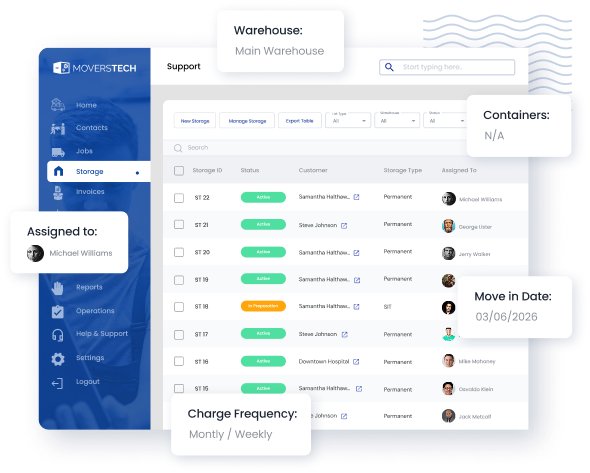
Most owners can tell you their monthly move volume instantly. Far fewer can clearly state their recurring storage revenue, active storage customers, or warehouse occupancy.
When storage income is blended into general revenue, margin visibility disappears. And when you cannot isolate it, you cannot improve it.
What changes when storage becomes a revenue strategy
When storage shifts from reactive handling to structured management, several operational and financial changes follow. The shift begins when storage stops being treated as a side service and starts being managed with intent.
Here is what changes:
- Recurring storage revenue becomes visible. You track monthly storage income clearly instead of blending it into general revenue.
- Warehouse occupancy becomes measurable. You monitor space by facility and zone, which improves planning and pricing decisions.
- Revenue becomes predictable. If 40 customers pay monthly storage fees, that income continues whether you run five moves or fifteen.
- Storage margin visibility improves. You see the difference between gross revenue and true storage profit.
- Cash flow planning strengthens. Predictable storage income reduces pressure during slower months.
At that point, asking if storage is a side service is a financial question. The numbers show whether storage supports the business or drives it.
The margin conversation most movers avoid
Revenue gets attention, but margin tells the real story.
Moving jobs generates strong top-line numbers, but they come with high variable costs such as labor, fuel, and scheduling pressure. Storage works differently. Once items are placed, labor drops while billing continues on a recurring basis.
This is where the question is storage a side service becomes financial rather than operational. Do you calculate storage profit separately from moving revenue, or does it remain blended into general income? When recurring billing is consistent and occupancy is monitored, storage can produce a steady margin with less daily volatility than move-based work. Companies that choose to automate moving company finances gain clearer storage margin visibility instead of blending it into general income. Without that visibility, it is easy to underestimate its contribution. Clear reporting strengthens cash flow predictability and improves control over seasonal swings.
When storage becomes operationally complex
Storage may start as an add-on, but complexity grows quickly with volume.
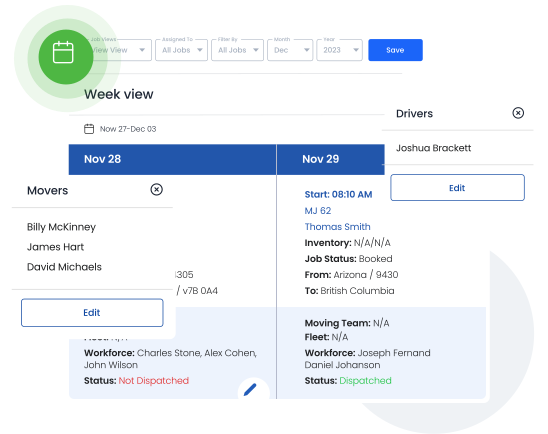
What begins as a few containers can expand into multiple zones, facilities, and long-term customers with different billing cycles. At that stage, informal processes start creating friction.
Tracking containers across spreadsheets, managing recurring billing, and separating short-term SIT from permanent storage all become critical. Without structure, errors compound and visibility drops.
The difference between “We offer storage” and “We run a storage operation.”
There is a clear operational gap between casually offering storage and managing it as a defined business unit. The words may sound similar, but the execution is very different. That difference often determines whether storage stays a support task or develops into storage as a revenue pillar.
When storage is treated casually, you often see:
- Manual billing is completed at the month’s end
- Inconsistent or unclear warehouse occupancy tracking
- Containers placed without structured zone control
- Extensions handled through emails or informal notes
- Storage records are separated from moving job data
This approach limits visibility and makes it difficult to measure total revenue per customer.
When storage operates as a structured business unit, you see:
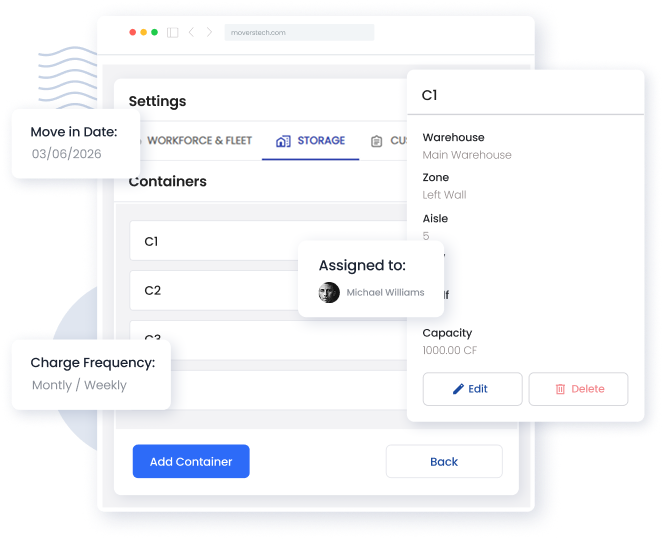
- Container locations tracked by facility and defined zones
- Scheduled recurring billing with fewer corrections
- Clear occupancy reporting and space planning
- Storage is connected directly to the customer’s job history
- Unified reporting across moving and storage activity
When you compare these two approaches objectively, the question is storage a side service begins to answer itself.
Why storage breaks without proper tracking and billing?
Storage does not become difficult because of volume alone. It becomes difficult when visibility and process do not keep up.
What feels manageable with a few containers quickly turns into confusion when tracking dozens of vaults, billing cycles, and aging balances manually.
When storage lives in spreadsheets and emails, it remains reactive. This is where storage management software becomes critical. Instead of patching together tools, you centralize occupancy tracking, billing, and customer data in one place.
When storage is managed through a centralized system, you gain clear visibility into occupancy, recurring billing, and customer history, which allows storage to operate as a structured revenue stream instead of a side process.
Storage as a hedge against seasonality
Every moving company feels the pressure of seasonality. Summer fills quickly, trucks stay booked, and revenue rises. Then volume slows, calls decrease, and fixed costs remain. You still pay rent, payroll, insurance, and warehouse expenses even when fewer moves are scheduled.
This is where storage operates as storage as a profit center instead of a temporary solution. Recurring storage revenue continues whether you run five moves this week or fifteen. Long-term storage customers generate predictable monthly income that does not depend on truck availability or peak demand. That stability strengthens cash flow consistency and reduces pressure to discount during slow periods.
When you manage storage deliberately, you smooth revenue swings and gain stronger control over planning, staffing, and growth instead of reacting to seasonal gaps.
How to evaluate your own storage position
Before deciding whether storage should become a larger focus, step back and review it with numbers, not assumptions. The issue is not only is storage a side service, but whether you manage it with structure, visibility, and financial control.
Use this checklist:
- Active storage customers – Can you see an exact count of current storage clients in real time? This number should not require manual filtering or spreadsheet review.
- Recurring storage revenue – Can you view total monthly recurring storage revenue instantly? You should know this number as clearly as your monthly move volume.
- Warehouse occupancy tracking – Do you track occupancy percentage by facility and zone? Empty space and overfilled areas both reduce efficiency and margin.
- SIT vs permanent storage separation – Can you clearly distinguish short-term SIT from long-term storage performance? Each impacts pricing, forecasting, and space planning differently.
- Billing consistency – Is recurring billing automated and aligned with contract terms, or handled manually at month end? Manual billing increases error risk and delays cash flow. Studies show up to 39% of manually processed invoices contain errors.
- Aging balances control – Do you monitor overdue storage accounts weekly? Aging reports protect margin and prevent revenue leakage.
If several of these answers require guesswork or extra effort, storage may still be operating as storage as a side service, even if it feels significant in daily operations.
Decide what role storage plays in your business
The real issue is not whether you offer storage, but how you manage it.
Storage becomes a side service when it is tracked loosely, billed inconsistently, and managed without visibility. When it is measured clearly, separated from moving revenue, and supported by consistent systems, it produces predictable income and stabilizes cash flow.
The difference is not in the service itself, but in how deliberately it is run.
Frequently asked questions
How do moving companies make money from storage?

Moving companies generate storage revenue through recurring monthly fees for storing customer items. Unlike moving jobs, which are one-time transactions, storage provides continuous income as long as items remain in the warehouse. When managed properly, this creates a stable and predictable revenue stream.
Is storage more profitable than moving services?
Storage can offer more stable margins than moving services because labor and operational costs decrease after items are stored, while billing continues monthly. Moving jobs often have higher revenue per job but also higher variable costs, making storage a strong complement for long-term profitability.
When does storage become a real revenue stream for movers?
Storage becomes a true revenue stream when it is tracked separately from moving income and managed with recurring billing and occupancy visibility. Once you can clearly see monthly storage revenue, active customers, and warehouse usage, it shifts from a support service to a predictable source of income.
Why do most moving companies underperform on storage revenue?
Most moving companies underperform on storage because it is not tracked as its own business unit. Revenue is often blended into total income, billing is handled manually, and occupancy is not measured consistently. Without visibility and structure, it is difficult to optimize pricing, margins, or capacity.
